


As a high-tech product, the Intelligent Electronic Customs Clearance Gate System serves as a pivotal tool for customs logistics oversight, playing a critical role in the monitoring of import and export containers and bulk cargo flows. The system collects real-time field data—including information on vehicles, containers, and electronic weighbridges—and integrates this with data from cargo manifests, customs clearance records, and logistics monitoring platforms. This comprehensive approach facilitates the on-site weighing, inspection, and release of import and export containers. Consequently, the system enhances customs inspection rates and ensures objectivity and impartiality, all without compromising clearance efficiency, increasing the burden on enterprises, or adding to the workload of customs officials. Furthermore, the vast volume of accurate, real-time logistics data generated by the system serves as a vital source for data analytics and risk-based targeting. Through such analysis, customs authorities can conduct purposeful and targeted inspections—or interdictions—at the gate for containers that have been flagged for monitoring, thereby significantly improving the accuracy of inspections.
The Intelligent Gate System primarily focuses on the automated collection of data from vehicles passing through the gate lanes; this includes weight measurements, container number capture and recognition, and RFID tag identification. All collected data records and associated imagery are stored in a backend database. Subsequently, this captured and identified data is transmitted to a centralized customs monitoring platform for cross-verification. Based on the verification results returned by the platform, the system determines whether to authorize release and raise the barrier, thereby achieving automated, unmanned supervision at the gate lanes while ensuring both data integrity and the rigor of regulatory oversight.
The primary function and purpose of the front-end component of the Electronic Customs Clearance Gate System is to collect various types of information regarding containerized vehicles traversing the main import and export channels. This data is then interfaced with the customs management platform database for transmission and cross-verification. By facilitating this process, the system serves to reinforce the customs authority's regulatory oversight of import and export cargo and aids in the rigorous suppression of smuggling activities. Fundamentally, the system embodies an intelligent management paradigm, minimizing the need for manual intervention and extracting critical data points to facilitate efficient customs inspection.
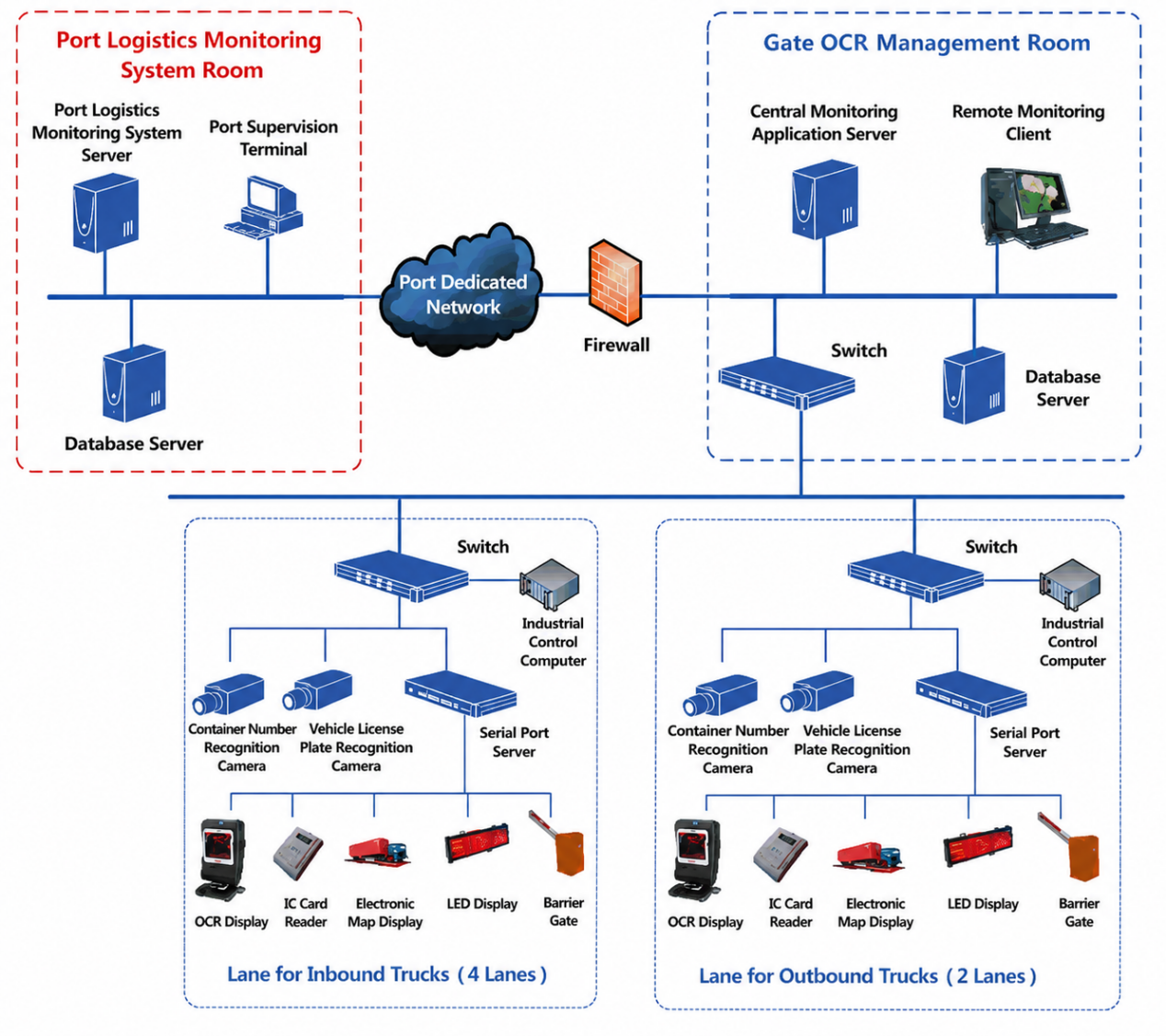
The electronic customs clearance system primarily consists of the following components:
1. Container Number Recognition Module: This module is primarily responsible for capturing container identification numbers.
2. License Plate Recognition Module: This module is primarily responsible for capturing the license plate numbers of container-carrying vehicles.
3. RFID Electronic Tag Module: This module is primarily responsible for capturing electronic tag information associated with designated, fixed vehicles.
4. IC Card Recognition Module: This module is primarily responsible for capturing information regarding temporary container-carrying vehicles.
5. Automated Release Control System: Comprising an electronic barrier and a main control unit, this system is primarily designed to intercept and manage unauthorized vehicles.
6. Weighing Data Acquisition Module: This module is primarily responsible for capturing the weight data of passing vehicles.
7. Integration with the Customs Electronic Port Management Platform: This component facilitates the interface between the front-end data acquisition system and the Customs back-end management system, enabling data sharing to support both manual and automated information verification. Concurrently, data is transmitted to the back-end, thereby enabling Customs authorities to exercise oversight and supervision over front-line port operations. Additionally, this module may incorporate the integration of inspection and quarantine data—such as readings from radiation detectors and X-ray scanners—into the overall data acquisition stream.
Overall Architecture Diagram of the Electronic Customs Clearance System:
英文
Your Name
E-mail*
*Phone/WhatsApp
Company
Content


